
Visit Our Sister Company


Security Planning for CAMPAIGNS
iN AN ERA OF Heightened Tension
Campaign security planning is the process of preparing people, places, and procedures for the physical risks that can accompany public-facing political activity. The objective is not to predict every disruption. It is to establish a proportionate plan for protecting staff, volunteers, attendees, property, and ongoing operations if conditions change.
Campaigns face a different operating problem than multi-location businesses preparing for election-year disruptions. Offices, rallies, fundraisers, public appearances, and volunteer events can change locations, attendance levels, and public visibility quickly.
When outside support is appropriate, commercial security guard services should fit into a broader plan rather than operate as a stand-alone solution.
That makes preparation more useful than generalized assumptions about political risk. A credible plan defines responsibilities, access expectations, communication paths, and escalation criteria before an event or incident forces those decisions in real time.
Start With Site- and Event-Specific Risk
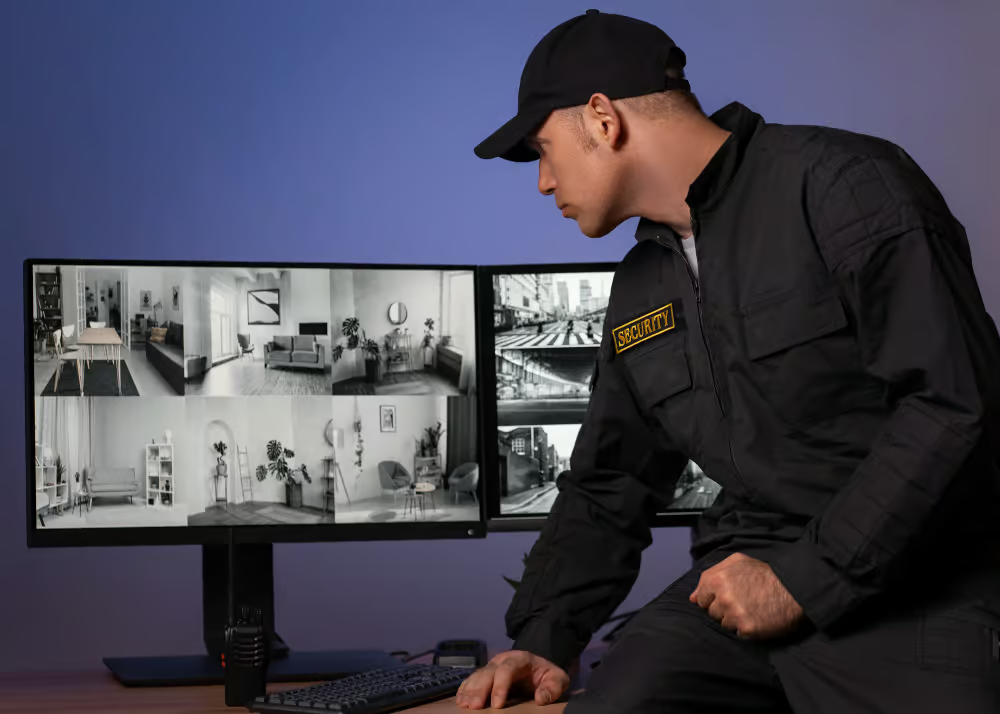
Campaign security should begin with the setting, not with a blanket assumption that every political activity requires the same coverage. A campaign office with regular staff and volunteer traffic has different needs from a large rally, a private fundraiser, or a temporary event venue.
The assessment should account for factors such as expected attendance, public access, venue layout, restricted areas, nearby activity, transportation and parking conditions, scheduled demonstrations, and the presence of public figures. The goal is to identify what could interfere with safe operations and what controls are reasonable for that specific environment.
FEMA’s Exercise Starter Kits include a Large-Scale Events package for validating plans, policies, and procedures while emphasizing coordination and collaboration among relevant stakeholders. Campaign planners can apply the same risk-informed principle without assuming a campaign event is equivalent to a major public special event.
Control Access Without Creating Unnecessary Friction
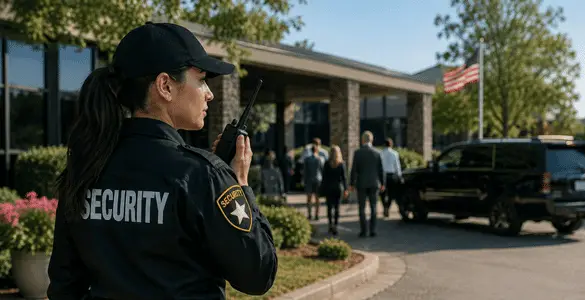
Access planning should clarify who can enter, where they can go, and how restricted spaces are handled. That may include separating public entry from staff or vendor access, defining credential expectations, and identifying who has authority to resolve an access problem.
The level of control should match the event. A small volunteer gathering does not need the same process as a high-attendance rally. Overly complex security can create bottlenecks and unnecessary tension, while vague access rules can lead to inconsistent decisions by staff and security personnel at the door.
Clear access rules and decision authority matter more than added complexity. Staff, venue personnel, and security should understand the same boundaries before attendees arrive, especially when multiple organizations share responsibility for the location.
Prepare for Demonstrations and Fast-Changing Conditions
A demonstration or counterdemonstration should not automatically be treated as a security incident. Security planning should remain politically neutral and behavior-based, with escalation tied to observable safety, access, or property concerns rather than viewpoints or affiliations.
The plan should consider how entrances remain usable, how staff receives updates, and what happens if crowd activity changes the normal flow around a venue or office. It should also establish who is responsible for deciding whether an event continues, pauses, relocates, or uses an alternate access arrangement.
The U.S. Fire Administration civil unrest response guidance similarly emphasizes focusing on communications planning, coordination, and adapting operations as conditions change.
This is where scenario planning matters. Teams do not need a script for every possible event, but they should know the decision path if conditions move from routine activity to a disruption that affects people or operations.
Define Communication and Escalation Before an Incident
Communication failures can turn a manageable disruption into a larger operational problem. Campaign staff, venue management, and professional security should know who receives reports, who makes decisions, and when to contact law enforcement or emergency services.
Current FBI special-event security guidance emphasizes coordination, information sharing, and joint threat assessment among partner agencies before and during large public events.
The FBI also describes command posts where partner agencies exchange information and deconflict activities, reinforcing the need to define responsibilities instead of assuming outside agencies will automatically manage an event.
For campaign planners, the useful takeaway is simple: roles should be clear before the event begins. Contact paths, escalation expectations, and decision authority should not depend on people finding the right person after a problem has already developed.
Match Security Coverage to the Setting
Professional security is one component of the plan, not a guarantee against disruption or violence. Coverage should be based on the location, attendance, event type, operating hours, access needs, and other site-specific conditions.
That may mean a visible security presence at one event and a more limited access-control or monitoring role at another. The purpose is to assign responsibilities that support the broader plan, not to default to the most intensive posture available.
Campaign organizations should also define what security personnel are expected to document, who supervises the assignment, and how changing conditions are communicated. Those details make coverage easier to evaluate and reduce ambiguity if an incident or service issue needs review later.
Build Continuity and Post-Event Review Into the Plan
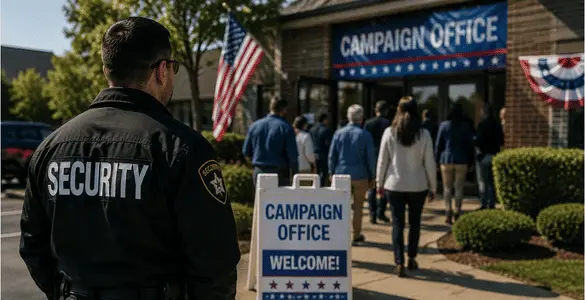
Security planning should address what happens to campaign operations if normal activity is interrupted. Offices may need alternate access arrangements, events may need a clear pause or cancellation decision path, and staff may need instructions for communicating operational changes without creating confusion.
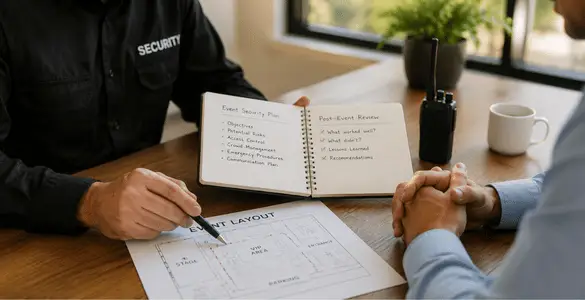
Incident reporting is part of that continuity process. A useful record captures what happened, when it happened, who was notified, and what follow-up was required. After an event, the campaign can review whether access procedures, staffing, communication, or escalation expectations need to change before the next appearance or gathering.
That review keeps the plan adaptive. Campaign activity moves quickly, so lessons from one location or event should inform later decisions without becoming a rigid assumption that every venue presents the same risk.
Five Questions To Ask Before Finalizing Campaign Security Plans
What site- or event-specific conditions should drive the security plan for this location?
Who controls access decisions, restricted areas, and credential exceptions?
What communication and escalation path applies if conditions change?
How will campaign staff, venue personnel, professional security, and public-safety partners coordinate where appropriate?
What incident documentation and post-event review will be used to improve the next plan?
What Campaign Operations Teams Should Focus On
Effective campaign security planning is less about reacting to political tension than about reducing uncertainty around physical operations. The strongest plans are neutral, proportionate, and specific about who is responsible for access, communication, escalation, continuity, and documentation.
The right level of professional security will vary by campaign, venue, and event. What should remain consistent is the operating discipline: assess the setting, define responsibilities, coordinate with the appropriate partners, and review what happened so the next decision is better informed.
Frequently Asked Questions
What security measures should retail stores take during election season?
Follow these six steps to make a robust security plan during the election year.
- Conduct site-by-site risk assessments.
- Increase guard presence.
- Adjust staffing during peak times.
- Brief guards on de-escalation protocols.
- Coordinate with local law enforcement.
- Monitor conditions in real time.
How do election protests affect multi-location retail operations?
Election protests cause uneven disruptions across locations, affecting access, staffing, and customer flow. High-density areas and locations near civic buildings typically experience the most operational strain. For example, a store near a downtown courthouse may need guards briefed to manage sidewalk congestion and maintain clear entrances if a demonstration forms nearby.
When should retailers begin election security planning?
Retailers should begin planning in early Q3 and complete core assessments by September to be adequately prepared before early voting and Election Day. Reviewing potential security scenarios in advance allows teams to evaluate coverage options methodically, rather than making rushed decisions under pressure.
How do you brief security guards for politically sensitive environments?
Brief guards using location-specific scenarios, clear rules of engagement, and defined communication protocols. Emphasize de-escalation, awareness, and strict neutrality. For example, a guard working near a public gathering area should be prepared to monitor a peaceful protest without engaging, while knowing exactly when behavior crosses the threshold for escalation.
Stay Ready with Election Year Security Planning
One advantage of planning staffing, logistics, and crowd control during an election year is the predictability of the timeline: you know when early voting begins, when national days of protest may occur, and exactly when Election Day will take place.
Start building a plan now to support 24/7 operations across your locations, including clear emergency protocols and a focus on efficient execution. Contingency plans for every possible scenario should be in place by September. Election year security planning can also serve as a template for subsequent annual safety reviews. Guard Services USA, a qualified guard services partner, can accelerate this process significantly.